Denoising Embedding Models Are Self-Supervised Learners
- Paper
- Code
- BibTeX
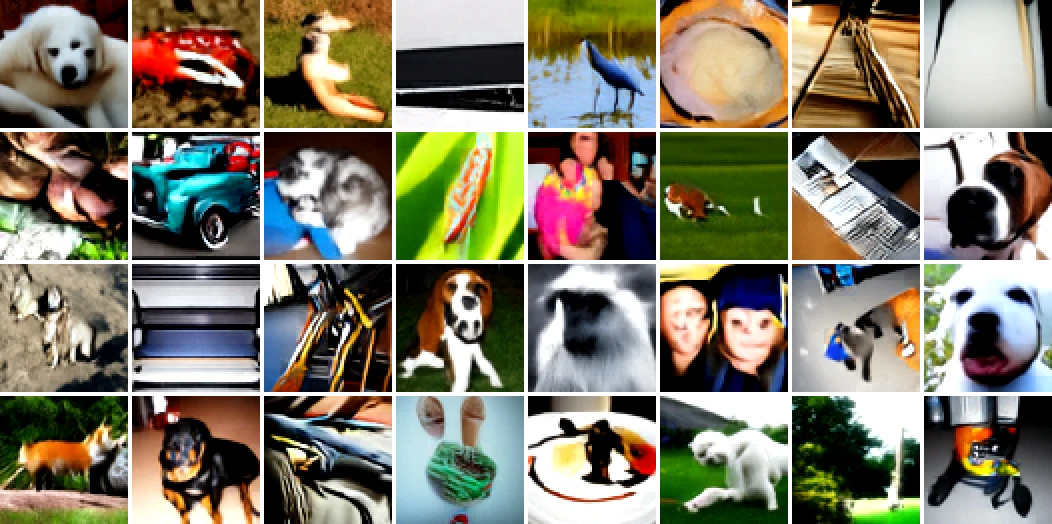
For the past two years, I have worked on generative world models for control. In my DRIFT project, I found that the features of a denoising model are less suited to control. One explanation is that reconstruction does not produce invariant, abstract features. This is also part of why Yann LeCun favors joint-embedding methods such as JEPA over generative models.
I was mostly fascinated and consumed by diffusion models, so I went looking for a diffusion-native solution to both representation and generation. In this project, a single denoising objective trains one network to do both. The network generates representations and pixels, so representation learning and generation share one model and one objective. In this view, self-supervised learning becomes a form of generative modeling.
Abstract
This paper shows that a generative model trained only by denoising can learn visual representations competitive with self-supervised learning and generate images without labels. Our approach is simple. In joint-embedding self-supervised learning, a network predicts the embedding of one view of an image from another view. We observe that this prediction is denoising at full noise, where the noisy embedding carries no information. We train the network on this view-conditioned denoising at all noise levels and call the result a denoising embedding model (DEM). A DEM is a diffusion model in representation space, with self-supervised prediction at its full-noise end. Without the view, the same network generates embeddings, and as a pixel denoiser it turns them into images. On ImageNet-100, DEM's linear probe exceeds that of DINOv2 at the same training length (76.1% against 72.8%). With a single network, it generates without labels at FID 26.1, against 22.9 for RCG, which trains three separate models. We hope this simple model will motivate rethinking self-supervised learning as a form of generative modeling.
These are current results on ImageNet-100 at 64x64 resolution. They may change as the work progresses.
Method
In joint-embedding learning, a network predicts the embedding of one view of an image from another view. Suppose the network also receives a noisy copy of the embedding it predicts. If the copy is pure noise, it carries no information, and the task reduces exactly to self-supervised prediction.
We train the network on this view-conditioned denoising at all noise levels. Without the view, it samples embeddings as a representation generator, and as a pixel denoiser it turns them into images. Its features also serve as the image representation.
Results
| DEM | Baseline | |
|---|---|---|
| Linear probe | 76.1% | 72.8% (DINOv2) |
| FID-50k without labels | 26.1 | 22.9 (RCG, three models) |
ImageNet-100, 64x64, current results.
One embedding, many images
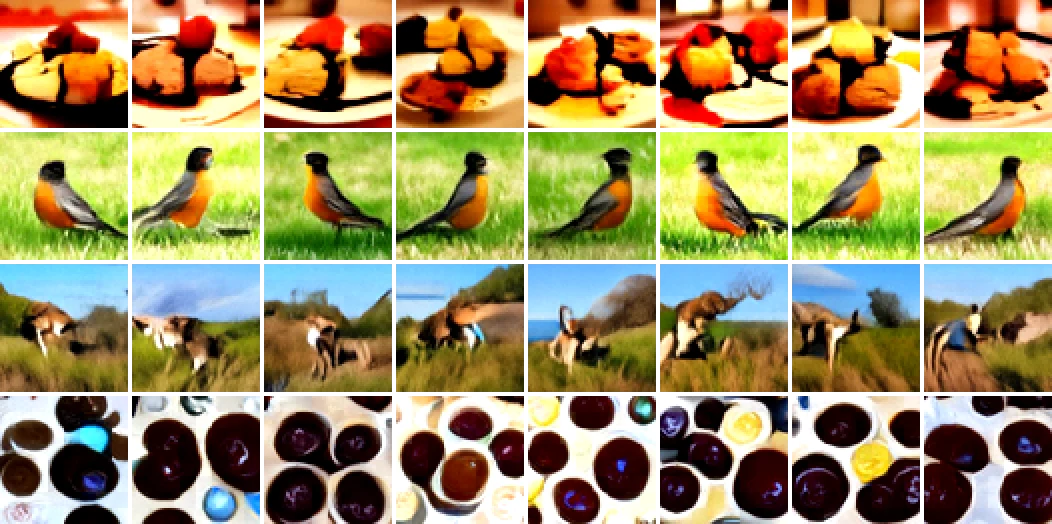
The embedding is learned from views of the image. It can therefore stay invariant to color and framing, while the pixel denoiser reproduces these variations.
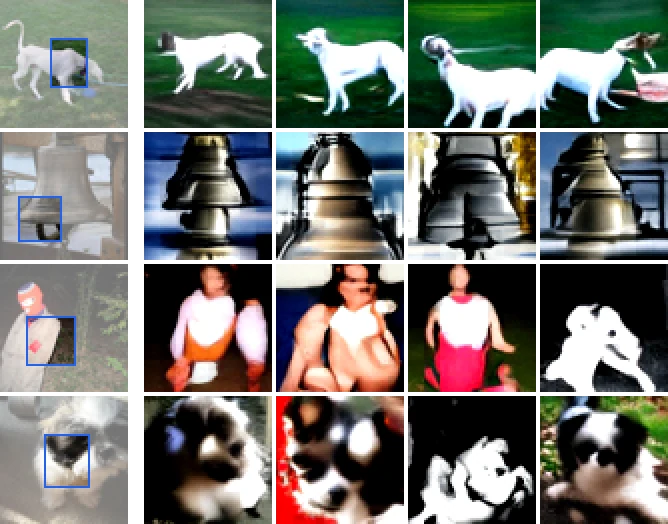
Completing a crop
Below full noise, samples spread more as the view shows less of the image. A small crop fits many images, so the embeddings sampled from it decode to different images.
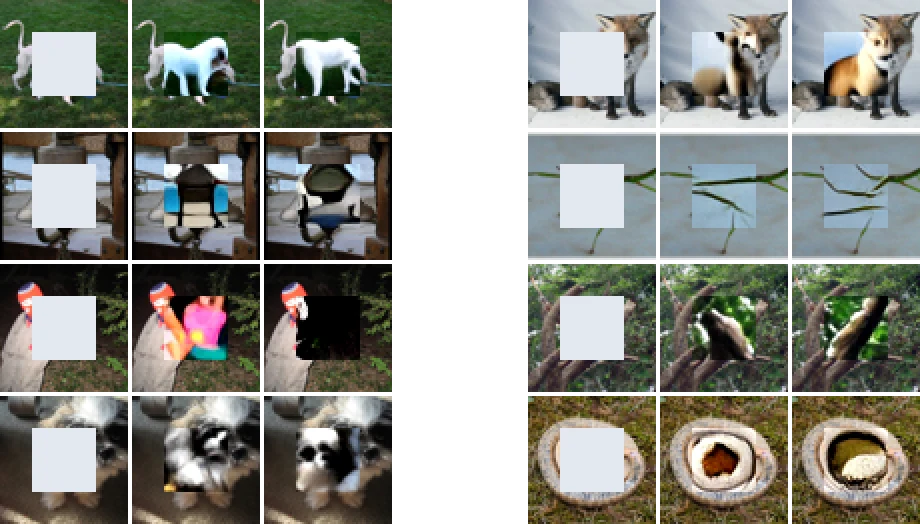
In-painting
If we keep the visible pixels while sampling, DEM fills in a hidden region without being trained for this task.
BibTeX
@misc{awal2026dem,
  title  = {Denoising Embedding Models Are Self-Supervised Learners},
  author = {Awal, Rabiul},
  year   = {2026}
}